


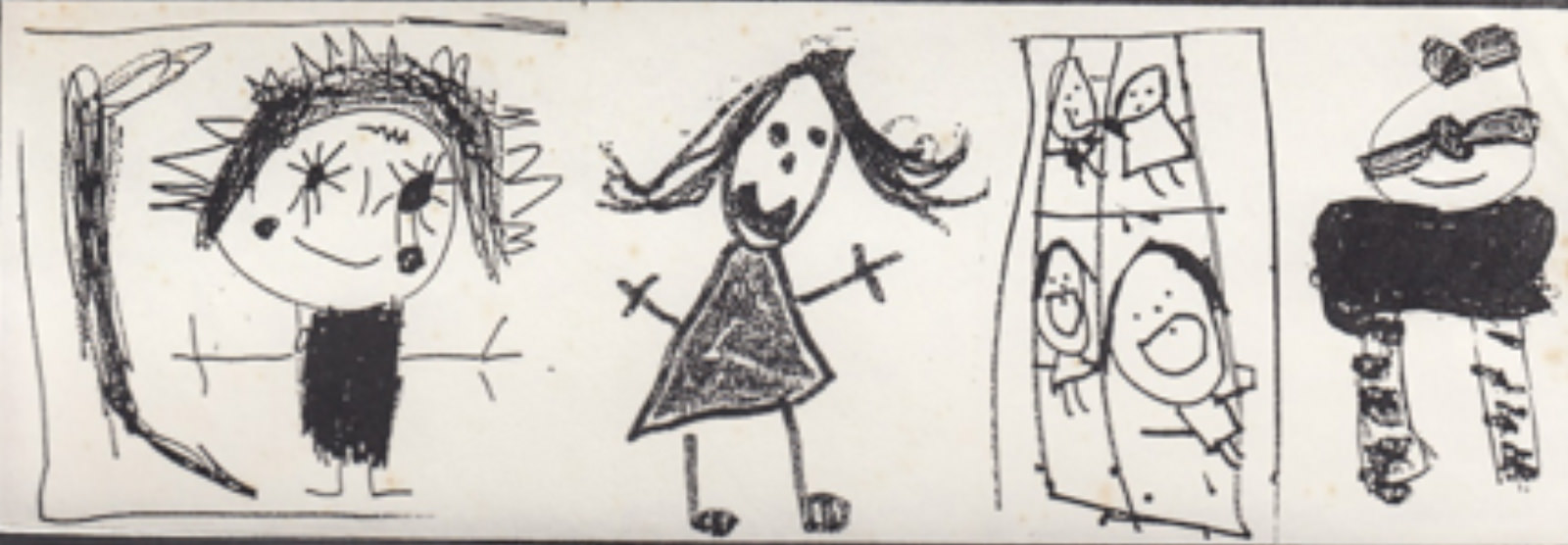


Since very young children love to make marks, they make random marks and scribbles as they investigate their environment. Experimenting gives young children the opportunity to learn by themselves about things like lines and their direction for example, they learn about different kinds of lines and the way they move, repetitions, textures and shapes. By experimenting and practicing drawing children remember the way they use tools like crayons, felt pens and charcoal, as they develop their own techniques.
Most of the children learn how to draw with practice. When they are very young children draw mostly from imagination; they draw their feelings and their ideas in an abstract way. Later on children start looking for other things to draw, it is at this point that children will need the guidance and support of teachers at school and parents at home.
What children draw?

Drawing of the never ending forest
They draw from imagination – things that they imagine – like a trip to the never ending forest.

Drawing of objects around the room
They draw from observation – they draw objects around the room, they draw from visual references and they draw from Nature, shells, seed pods, leaves, bark.
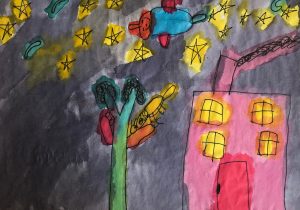
They draw from memory – children like to draw things they remember like for example: what they did in the summer holidays, their visit to grandmother, playing with friends, their home.

They draw their feelings – like a response to the question: have you ever felt lonely? or: what is home for you? Children draw happy pictures and sad pictures.
The practice of drawing for children over four years old

Practicing drawing can take place every day for a short time at kindergarten, school or at home. Four years old children love to keep sketch books and draw whatever they like to for periods of 10 or 15 minutes with black pens.
The drawing centre
 Setting up the drawing centre would be similar to painting, but it will have different materials. Drawing materials should be on display in shallow boxes or trays for easy access. It is better to set up the drawing centre with a few drawing tools to start with. Traditionally, children start drawing using wax crayons and felt pens.Later on, a variety of drawings tools like charcoal, chalk pastels and oil crayons can be introduced. Ink is a wonderful medium for children to use, used in combination with black pens children can produce amazing expressive and colourful drawings.
 For older children that are interested in drawing from observation a point of interest could be set up within the drawing centre. A basket with fruit and a cloth with patterns, a simple composition with a tea pot and a vase with flowers on a table or something that will spark their imagination like a few shells or seed pods or a group of kitchen tools.
Drawing tools
 Wax crayons are normally the first drawing tools followed by felt pens.Oil crayons are softer than wax crayons and their colours are brighter, they are ideal for children who want to explore colour.
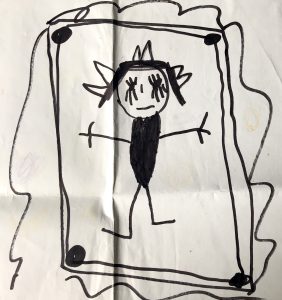 Black pens are great for children to use. Black pens are normally water resistant, therefore children can overpaint their drawings with water colours or coloured inks.
Young child drawing with natural charcoal
Natural charcoal is also recommended for young children. Compressed charcoal on the other hand wouldn’t be recommended as it is a very dense and messy drawing tool.
Young child drawing with natural charcoal.
Fluid paint like inks, liquid watercolours and diluted paint are excellent mediums for children to experiment drawing with sticks, feathers and small paint brushes.
Papers
Butcher’s paper, easel paper is good for beginners and as children gain experience by experimenting with drawing tools other papers could be introduced. Cartridge paper of about 120gsm or heavier is the most popular paper for young children, but drawing paper could be any kind and shape of paper. The paper supply will vary according budget.
Ink and watercolours

School quality inks are ideal for kindergarten children to draw using small paint brushes. Dry water colours, normally disks, are perfect to apply colour over a black pen drawing. Children will have to be instructed on how to use these two art techniques. Dry watercolours have to be wet by using the paint brush, children also will have to learn that by rubbing the colours with the wet paint brush they will be able to release bright colours.
Ways to inspire young children
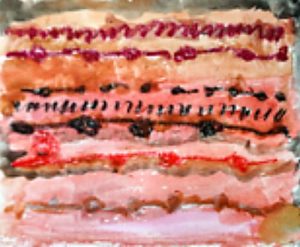

Most of young children love to draw and to tell stories as they draw. As young children draw mainly from imagination it is important at some point to encourage them to start looking to their surroundings and to learn about shapes, lines, colours and textures. A good activity is to go to the garden to find lines, shapes, colours and textures in Nature.
Pictures and objects to inspire children to draw are good additions to the drawing centre. Only very few objects and pictures should on be on display at one time. Pictures and objects can be refreshed every two or three days with the introduction of new items.
Art post cards, small reproductions of drawings, small picture books, pictures of animals, pictures of buildings, landscapes, flowers and people. Any suitable small pictures will be fine.
Collections of natural objects like twigs, pieces of bark, leaves, seed pods, flowers, small amount of foliage are good sources of inspiration.
Questions to trigger visual responses like: what did you have for dinner last night? Or where do you like to play?
Book reading: reading short passages of stories for children is a great way to trigger children’s imagination and they will produce wonderful illustrations of the stories.
Drawing video lessons
Drawing from Nature
Drawing with oil pastels
Drawing a portrait
This video shows drawing with dry pastels and can be adjusted for young children using oil crayons or felt pens. Children love to watch video lessons, and as teachers we should allow them to interpret the lesson using their own technique. This video will be a kind of guide on how to draw a face.


